4 June 2026
Today we look at Coinbase’s first Bitcoin-backed mortgage, Kalshi’s regulated Bitcoin perpetuals, Tether’s sugarcane-powered mining project in Brazil, AI’s creeping takeover of professional work, and why miserable market sentiment may be the moment to clear out some personal noise too.


Bitcoin is having one of those weeks where everybody is twitchy, every headline is designed to make you feel worse, and every market candle looks like mass human psychology having a panic attack. Coinbase and Better have now funded the first Fannie Mae-backed mortgage using Bitcoin as collateral, which is a real milestone. A married couple in Michigan used pledged Bitcoin instead of selling their stack, paying capital gains, and giving up future upside. That part is interesting. The structure is also interesting: one regular mortgage, one crypto-backed loan for the down payment, and Bitcoin collateral pledged at roughly 2.5-to-1.
The timing, of course, feels ugly. Bitcoin price action has been rough, sentiment is terrible, and nobody needs to pretend otherwise. But the loan structure does leave some headroom. If you borrow $100,000 against $250,000 in Bitcoin, that is not exactly reckless zero-margin behavior. Still, the larger point is not just “Bitcoin mortgage good” or “Bitcoin mortgage bad.” The larger point is that Bitcoin is being pulled into every corner of the financial machine while that machine itself gets louder, faster, and more distorted by the day.
That is what Kalshi’s new regulated Bitcoin perpetual futures market really represents. Yes, it is another sign that Bitcoin is being dragged onshore into regulated American markets. But it is also another sign that the world is addicted to markets for the sake of markets. Traders are not merchants sending ships across oceans, risking real goods, real weather, and real logistics. They are trading sentiment. They are trading direction. They are trading noise. The old merchants might have been rich and resented, but at least they moved actual goods and took actual physical risk. Today, half the market looks like capital rotating from one narrative to another at the speed of light.
And that noise is not limited to Bitcoin. The Dow can rip higher while the Nasdaq and S&P wobble. AI stocks can look unstoppable right up until they do not. Global access to U.S. markets is expanding, regulators are making more room for crypto-style products, and everybody everywhere wants into the same casino. That does not automatically mean a crash is coming tomorrow. It means nobody really knows what to do with their money, so they keep inventing more instruments, more venues, more leverage, and more ways to confuse price with value.
The better story this week may be Tether-backed Adecoagro preparing to mine Bitcoin in Brazil using electricity generated from sugarcane waste. That is the kind of thing that actually matters. Sugarcane bagasse already gets burned for steam and electricity. If there is surplus power, Bitcoin mining can turn that otherwise stranded or underused energy into something globally liquid. That fits into a much bigger idea: maybe “waste” is just a resource that has not found the right system yet. Waste heat, agricultural residue, synthesis gas from biochar production are inputs waiting for the right machine.
Then there is AI, which is not going away no matter how much people want to pretend it is a fad. Perplexity wants more AI work to happen on your own machine instead of in the cloud, partly because privacy matters, and partly because compute bills are enormous. Let us not be naive here. This helps the user, maybe. It definitely helps the company. It is the old SETI@home and Folding@home model, except now the people harvesting the spare compute cycles are for-profit AI companies.
AI is also starting to beat law professors at legal reasoning tasks, which should get everyone’s attention. But even there, the human does not disappear. The human becomes the bridge between meat space and compute space. AI can generate, reason, classify, summarize, and assist. But humans still decide which problems matter, what the real-world constraints are, and whether the answer survives contact with reality. The people who learn how to talk to compute space are going to have power. The people who refuse to learn may get left behind.
And finally, yes, Trezor disclosed a hardware vulnerability, while saying funds remain safe. That is exactly why I keep saying the same thing: use Bitcoin-only hardware built by people who are paranoid in the right way. I want a wallet made by hardcore Bitcoiners, not a shiny multi-coin gadget trying to be everything to everybody. Coldcard is still my go-to, and I keep hearing good things from serious Bitcoiners about BitBox. When it comes to cold storage, clean and paranoid beats cute and convenient.
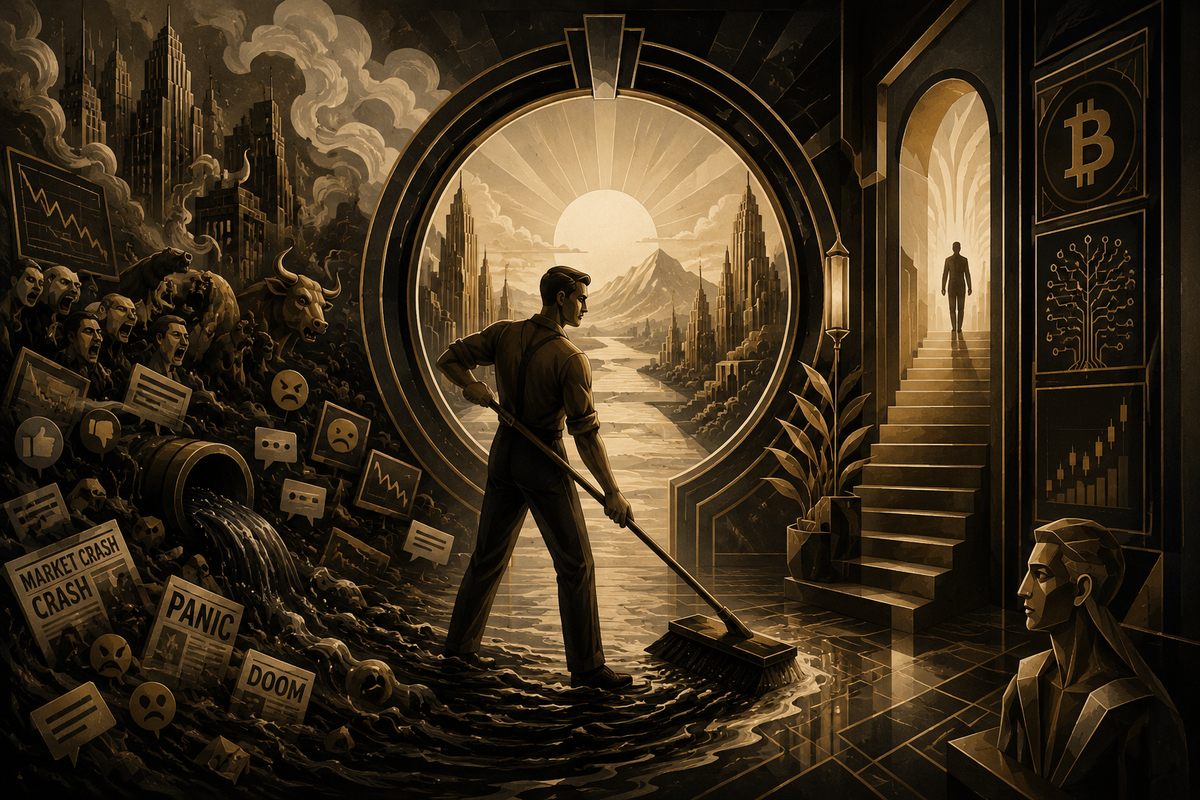
This is a hard week. The market is ugly, the headlines are ugly, and sentiment online is a sewer with a fresh clog removed. But maybe that is useful. Maybe when the noise gets unbearable, it forces you to notice what the noise has been covering up. Bitcoin can be down and still be Bitcoin. AI can be a bubble and still be real. Markets can be irrational and still move. The work is not to let every external signal turn into internal panic. Sometimes the job is to clear out the noise, look inward, fix what needs fixing, and get to the other side
Circle P Vendor of the Day
Bitcoin Beans
https://primal.net/BitcoinBeans
Bitcoin Beans takes proof of work from the mine to your mug. Regeneratively grown Colombian cacao, hand selected by farmers paid in Bitcoin, lab tested for purity, and priced in sats. This is whole-bean cacao, not candy. It is proof-of-work you can taste.
Use BITCOINAND code to receive a 5% discount

- Bitcoin backed mortgage
- Coinbase Bitcoin collateral loan
- regulated Bitcoin perpetual futures
- Tether sugarcane Bitcoin mining
- AI legal reasoning and Bitcoin markets

Member discussion: