12 May 2025
Today’s episode starts with Anthropic warning investors that unauthorized tokenized exposure to its private stock may be invalid, then moves through the CLARITY Act draft, Bitfarms’ AI pivot, Germany’s latest crypto tax grab, Bitcoin “power projection,” and a very real reminder that wrench attacks are no longer just a European problem.


The “tokenize everything” crowd has run straight into a pretty inconvenient problem: the actual company whose stock they claim to be selling might not recognize the deal at all. Anthropic, the AI company behind Claude, is now warning that unauthorized sales or transfers of its stock (or any interest in that stock) are void unless approved by its board. That includes SPVs, forward contracts, tokenized securities, and the usual “trust me, bro, I’ve got pre-IPO shares in my vest pocket” nonsense. Anthropic’s own warning says buyers may end up with no shareholder rights and no recognized claim on the company’s books.
That is the part people need to hear twice. Some of these markets are implying trillion-dollar-plus valuations on private companies while the actual backing can be tiny compared with the headline number. CoinDesk reported that PreStocks’ Anthropic market implied a valuation above $1.5 trillion while the platform held roughly $23 million in total assets. That is not price discovery. That is a narrative grenade with a ticker symbol attached. And it is exactly why I have been saying tokenized equities, tokenized pre-IPO shares, tokenized everything are ripe for scams, confusion, and eventual tears.
Meanwhile in Washington, the Senate Banking Committee’s CLARITY Act draft is trying to draw lines around digital assets, but the lines are already weird. One provision would stop the SEC from classifying any token as a security if it was the principal asset of a U.S.-listed spot ETF as of January 1, 2026. In plain English, that means Bitcoin gets through the gate, and Ethereum probably does too. Everything else gets to wander into the regulatory swamp and hope the alligators are in a good mood. The bill also creates a process where a token issuer can tell the SEC, “we’re not a security,” and if the agency does not object within 60 days, the filing becomes effective. That is not exactly confidence-inspiring.
Over in Germany, politicians are doing what politicians do: losing a tax fight, waiting five minutes, changing the wrapper, and trying again. Finance Minister Lars Klingbeil wants to eliminate Germany’s current rule that lets investors sell Bitcoin and other digital assets tax-free after holding for more than twelve months. Under the new plan, crypto gains would be hit with a flat 25% tax plus extras, regardless of holding period. And this is apparently the fourth attempt in eighteen months to kill that exemption. There is no cost to these people for reintroducing bad ideas over and over again until the public gets tired or distracted.
Bitfarms (now rebranded as Keel Infrastructure) is another reminder that chasing the new hot thing does not magically fix the old business. The former Bitcoin miner reported a $145 million Q1 net loss while shifting toward high-performance compute and AI infrastructure. The AI data-center story may work for some companies, especially those with power, land, capital, and scale. But cutting away from Bitcoin mining to go all-in on AI is a big bet, and smaller players can get swallowed fast in a market full of giants. “We have a vision” is nice. Cash flow is nicer.
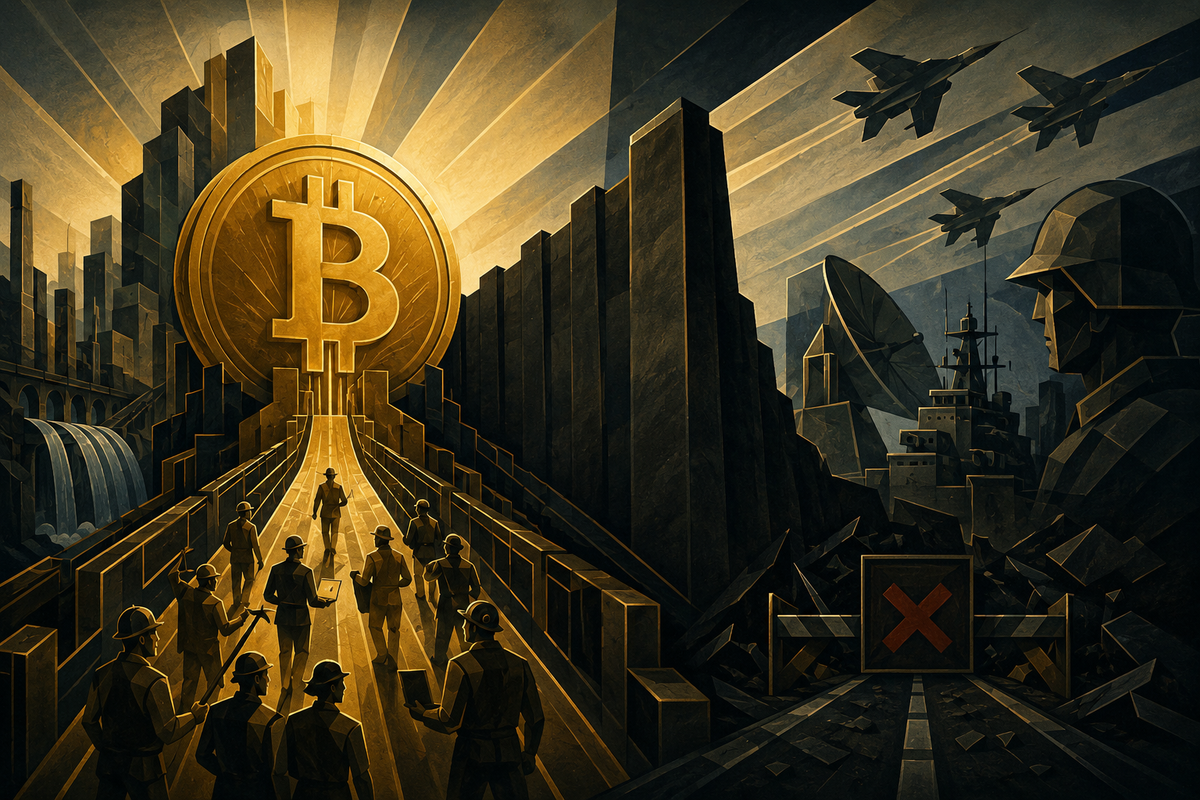
The second half of the show got into Bitcoin and military “power projection,” and this is where the theory runs into the wall. Yes, Bitcoin’s proof-of-work is one of the most important inventions in computer science. Yes, it can inspire new ways of thinking about spam, denial-of-service attacks, authentication, and network defense. But Bitcoin itself is money. That is what the network is built for. Its incentives, miners, users, developers, and security model all point in that direction. Every time somebody tries to strap a second grand mission onto Bitcoin, whether ordinals, identity, military signaling, or some “Bitcoin-but-for-battle-plans” fantasy, the thing usually ends up in a dead end. The inspiration may be useful. The piggybacking usually is not.
And then there is the ugly, physical side of all this. Three Tennessee men were indicted over alleged crypto robberies in California, where prosecutors say they posed as delivery people, entered victims’ homes, used firearms, duct tape, and zip ties, and forced transfers of millions in crypto. One alleged incident involved $10 million in Bitcoin and $3 million in Ethereum. This is the part where everyone needs to stop treating opsec like a hobby. Delivery drivers are everywhere now. People are desensitized. Let the package hit the porch. Wait. Look. Then open the door. Bitcoin removes the bank from the middle, but it also removes the fantasy that someone else is responsible for your security.
Circle P Vendor of the Day:
Maple Trade
Maple Syrup and Soaps
SHOP -> https://www.takemysats.com/mapletrade-maple-syrup
Use code BitcoinAnd
nostr handle: https://primal.net/p/npub172mu27r5yny0nnmvgjqwhx055dmsesrrx7j0p5d3pxagfx6xgxfsv75p3q
Twitter: https://x.com/beisnerds

- Tokenized pre-IPO stock risk
- Anthropic tokenized shares warning
- CLARITY Act Bitcoin Ethereum
- Germany crypto tax exemption
- Bitcoin wrench attack security

Member discussion: